AI Agents for Logistics: Automation and key improvement areas to reduce operating costs in 2026
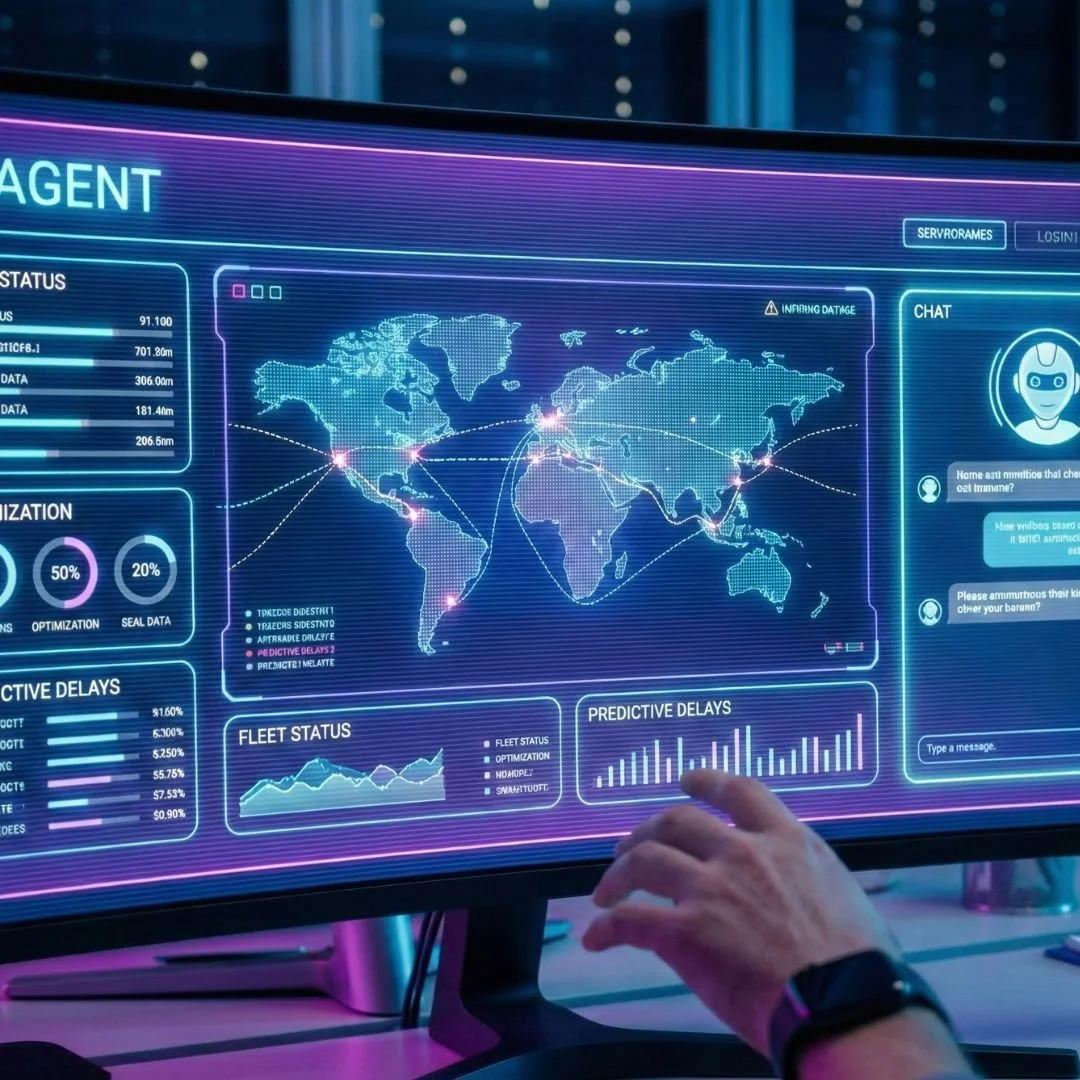
The logistics landscape in 2026 is defined by one word: uncertainty. From shifting trade policies to volatile fuel prices, supply chain leaders can no longer rely on static planning. For CEOs and VPs, the challenge is no longer just moving goods from point A to point B; it is doing so while protecting margins in a high-inflation environment. Traditional software shows you what happened yesterday, but AI agents for logistics are now providing the ability to act on what is happening right now.
In addition to providing visibility, these autonomous agents are taking over the heavy lifting of daily decision-making. By moving beyond basic dashboards, companies are finding that they can finally close the gap between planning and execution. This shift is turning logistics from a back-office expense into a strategic engine for growth.
From Dashboards to Decisions: Why traditional tracking isn’t enough
For years, the gold standard in the industry was "visibility." Managers invested heavily in platforms that showed them where their trucks were on a map. However, visibility without action is just more noise for an already overworked team. If a shipment is delayed at a port, knowing about it doesn’t solve the problem—it only starts a chain of manual phone calls and emails to find a workaround.
This is where supply chain automation enters a new phase. Unlike older systems that simply alert a human to a problem, an AI agent can analyze the delay, search for alternative carriers, and propose a new route in seconds. Instead of a manager spending two hours on a "fire drill," they spend two minutes approving a pre-vetted solution.
Consequently, the role of the logistics team is shifting. They are moving away from manual troubleshooting and toward high-level strategy. This transition is essential for any company looking to scale without ballooning their administrative payroll.
How Digital Dispatchers solve the "Last-Mile" crisis
The "last mile" remains the most expensive and complex part of the delivery journey. In 2026, customer expectations for speed have hit a ceiling, but the labor and fuel costs to meet those expectations continue to rise. Digital dispatchers are proving to be the most effective tool for managing this balance.
Real-time route optimization
A human dispatcher can plan a morning route effectively, but they cannot account for a sudden traffic accident or a flash weather event that occurs at 2:00 PM. Digital dispatchers monitor live data feeds constantly. If a route becomes blocked, the agent pushes a new path directly to the driver's mobile app. This ensures that delivery windows are met without wasting fuel on idling engines.
Dynamic delivery window adjustment
When a delay is truly unavoidable, communication is the only way to save the customer experience. AI agents can automatically calculate the new estimated time of arrival (ETA) and notify the customer via SMS or email. For instance, this proactive approach reduces the volume of "Where is my order?" calls to your service center, further lowering your overhead.
Quantifying the ROI: How to reduce logistics costs by 15%
When presenting to a board of directors, the conversation always returns to the bottom line. Early data from 2025 and 2026 indicates that integrated supply chain automation can reduce logistics costs by as much as 15% within the first year of full implementation. These savings come from four primary areas:
Fuel Efficiency:
By eliminating "empty miles" and optimizing paths, fleets see a direct drop in fuel consumption.
Labor Savings:
Automating the carrier vetting and bidding process allows a smaller team to manage a much larger volume of freight.
Reduced Detention Fees:
AI agents track port and warehouse congestion, scheduling arrivals only when a dock is likely to be free.
Lower Error Rates:
Manual data entry is prone to mistakes that lead to expensive shipping corrections. Agents handle the paperwork with 100% accuracy.
Moreover, these savings are not one-time events. Because AI agents learn from every shipment, your network becomes more efficient every single month. To see how these technologies fit into a broader IT strategy, you can explore our Mobile App Development Services to see how we build the interfaces that connect your team to these agents.
Building a Resilient Supply Chain Automation Strategy
The move toward an autonomous supply chain doesn't have to happen overnight. In fact, for many VPs, a "pilot and scale" approach is the safest path to success. The goal is to identify a single, high-friction process such as inbound freight scheduling and assign an AI agent to manage it.
Specifically, this allows your team to build trust in the technology while seeing immediate ROI. Once the first agent is successful, you can begin to link multiple agents together. This creates a "connected intelligence" where your warehouse, your fleet, and your procurement department are all communicating in real-time.
Ultimately, the companies that thrive in 2026 will be those that stop reacting to disruptions and start predicting them. By implementing supply chain automation, you are not just buying software; you are building a digital workforce that never sleeps and never misses a detail.
Finding the competitive edge in a high-cost market
We are entering an era where the cost of manual operations is becoming a liability that few companies can afford. AI agents for logistics provide the precision and speed necessary to stay profitable when margins are thin. By choosing to reduce logistics costs through intelligent automation today, you are positioning your company to lead the market tomorrow.
The transition from manual to agentic workflows is the defining challenge of the next two years. Those who embrace it will find themselves with a leaner, faster, and more resilient operation that is ready for whatever the global market throws at it next.
Ready to see how AI agents can transform your specific operation?
Contact us for a comprehensive process analysis and start your journey toward an autonomous supply chain.