Beyond Automated Conversations: The Leap to AI Agentic Process Automation
In the recent wave of digital transformation across sales and operations teams, many companies have deployed AI chatbots to handle customer inquiries and internal support at scale. Initially, these tools were hailed as the cutting edge of conversational AI, offering a way to provide instant responses to common queries.
However, as operational demands become increasingly complex, many leaders are realizing that simply "answering" is no longer enough. For a manager, the ultimate objective isn't merely a system that displays information on a screen. It’s leveraging a system capable of completing the task at hand that ensures customer satisfaction while seamlessly triggering internal actions to manage the contact effectively. This represents the fundamental shift from basic bots to Enterprise AI Agents.
Beyond just answering questions, an agent possesses the authority and technical capacity to execute actions across the entire corporate software stack, routing every request to the correct person or process. This transition toward autonomous workflows is what distinguishes a mere communication tool from a true strategic asset that directly impacts profitability and team efficiency.
Closing the "Action Gap" with Agentic Process Automation
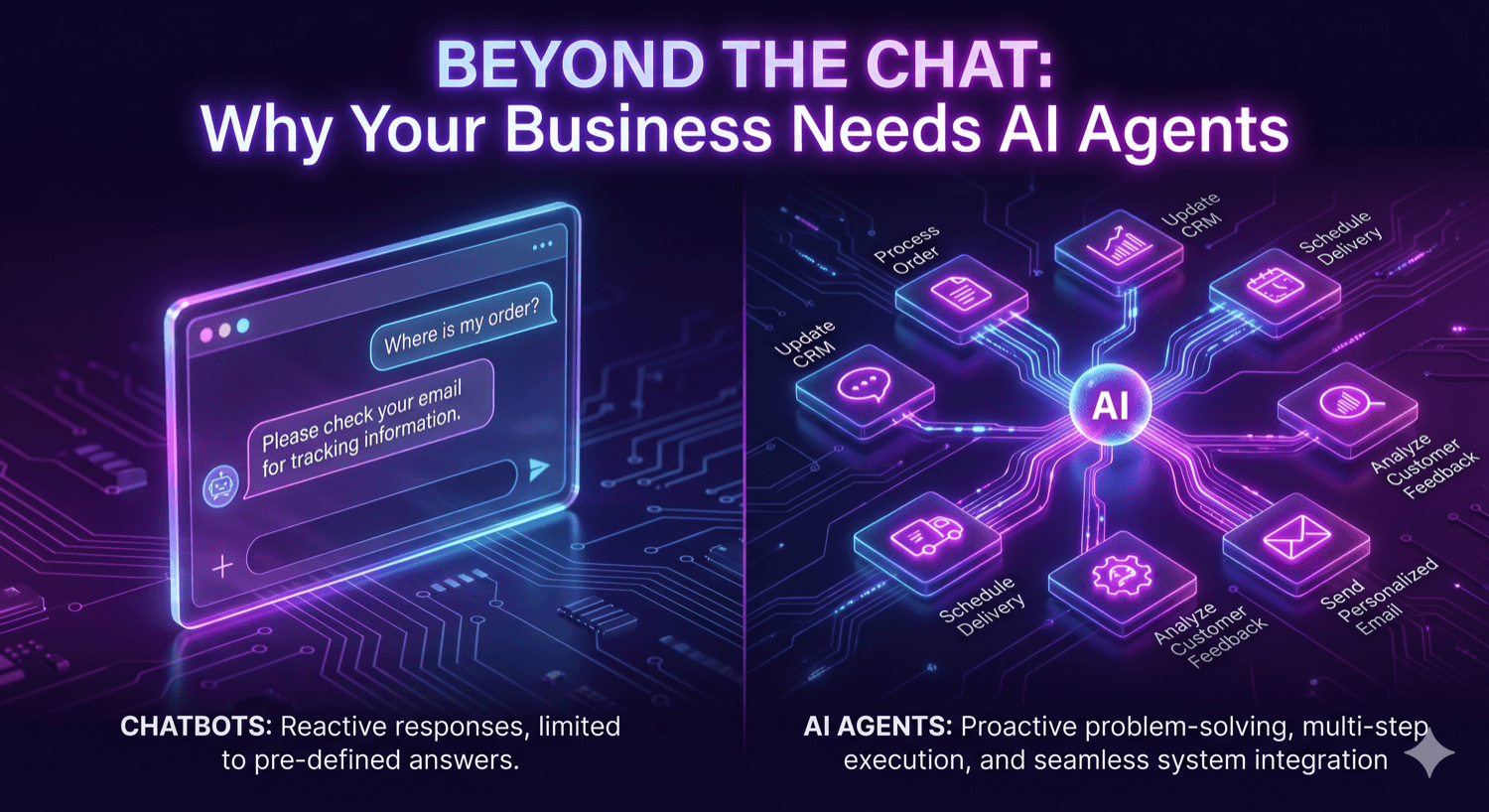
To understand the industry's trajectory, we must first recognize the operational limits of traditional chatbots. Most conversational AI was designed as a search interface: a faster way for a human to find a document, a policy, or an order status.
While this saves research time, the actual heavy lifting behind the scenes still falls on the staff to resolve the customer's needs. If a client asks a chatbot about their order status, typically a representative still needs to manually log into the carrier portal, notify the customer, and update the internal ERP to reflect the change.
In contrast, Intelligent Automation changes this dynamic by giving software true agency and resolution power. Instead of merely reporting a delay, an AI Agent can analyze the key elements of the request, prepare an action plan, and push updates to all stakeholders. It shifts from being a simple messenger to an active participant in problem-solving. Consequently, the ROI shifts from "time saved on searches" to "results achieved automatically." For industries where precision and speed are non-negotiable, this distinction is the key to maintaining a competitive edge against well-positioned rivals who still rely on legacy systems.
The "Action Gap" and Autonomous Workflows
The "Action Gap" is the latency between identifying a business problem and resolving it effectively. Chatbots identify problems; agents solve them. By utilizing autonomous workflows, these agents can connect email, customer databases, and custom mobile applications without requiring a human to copy and paste data across screens.
Impact on Logistics and Manufacturing
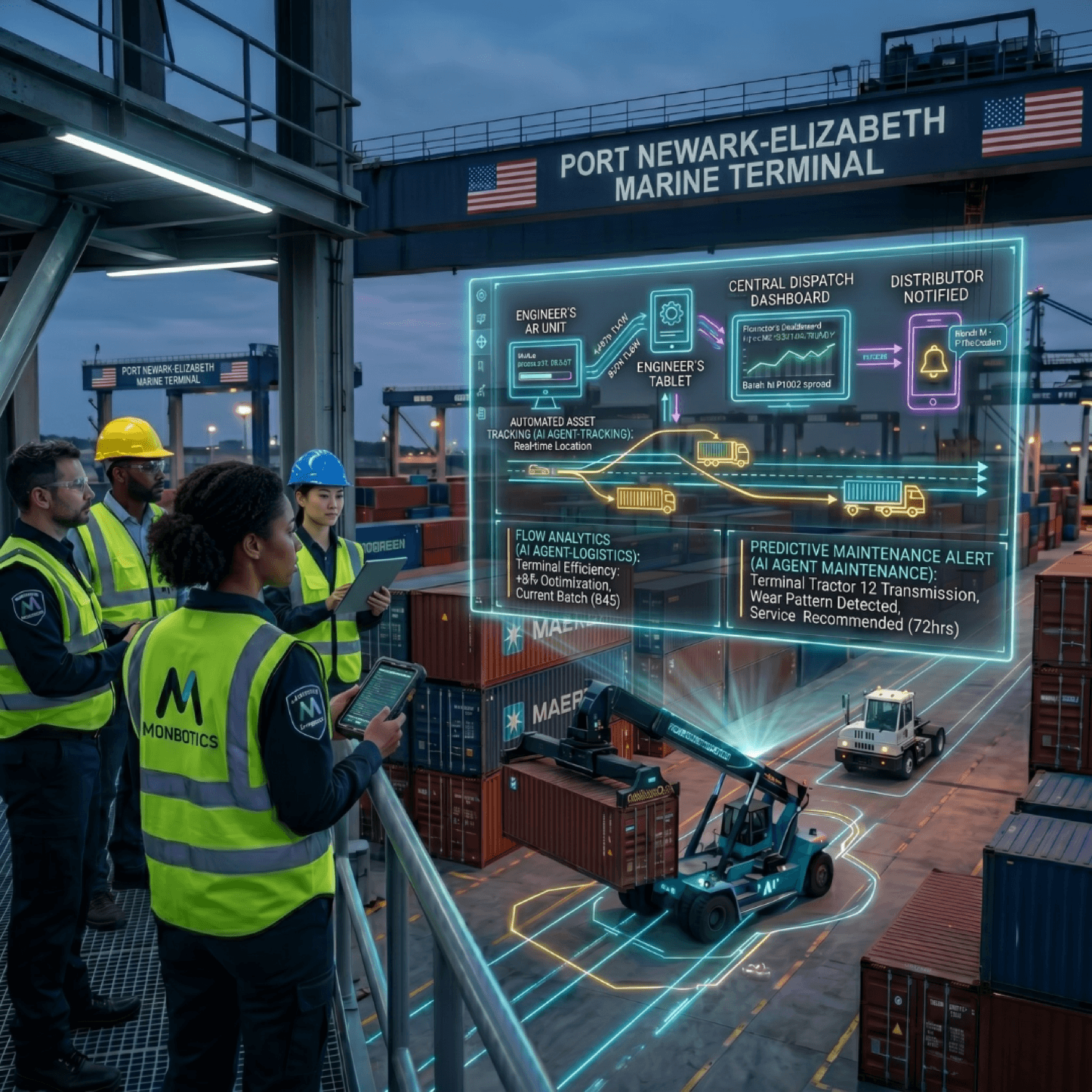
In the manufacturing sector, an agent can monitor raw material inventory in real-time. When it detects an imminent shortage, it doesn't just alert a plant supervisor; it can request quotes from pre-approved vendors, compare delivery timelines, and draft a purchase order for final approval. By the time a procurement manager reaches their desk in the morning, the "problem" has already been investigated and a solution is waiting for their sign-off.
Precision in Banking and Retail
In banking, where compliance and fraud detection are critical, delays are unacceptable. An agent can perform real-time audits of thousands of daily transactions. If a discrepancy is found, it can freeze the specific transaction and initiate a verification protocol immediately. In retail, agents can manage complex returns by verifying the original purchase, updating warehouse inventory, and processing the refund; all within a single intelligent automation cycle.
Strategic Tip: Mobile Integration and RPA for a Total Solution
An AI agent is significantly more effective when connected to the "hands" and "eyes" of your organization. A common corporate pitfall is leaving an agent isolated in a chat bubble on a public website. To truly transform a business, Enterprise AI Agents must be integrated directly with Robotic Process Automation (RPA) and internal mobile platforms.
Furthermore, the most successful operational strategies utilize mobile apps as the primary interface for employee interaction. A field technician in a warehouse can use a mobile app to communicate with an agent which, in turn, activates a digital worker (RPA) to update a legacy administrative system at headquarters. This creates a seamless loop where the mobile user, the agent, and the back-office software act as a unified team. This integration ensures that critical data never gets "stuck" in a silo. By tethering your mobile strategy to your core systems, you empower your field team with the full weight of a digital workforce right in their pocket.
The Monbotics Strategic Approach
At Monbotics, we believe technology must always follow business logic, not dictate it. Our methodological approach to implementing advanced solutions begins with a deep, objective analysis of your current manual bottlenecks. We specialize in high-impact industries including logistics, banking, manufacturing, and retail, where the cost of a slow response is exceptionally high.
Our consultative process is built on three fundamental pillars:
Process Discovery:
Identifying exactly where your team loses time on "bridge tasks" between disconnected software platforms.
Agent Customization:
Building bespoke tools tailored to the strict regulations of banking or the complex logistics of a global supply chain.
End-to-End Connectivity:
Ensuring these tools are fully integrated with your back-office software and mobile apps to completely eliminate the Action Gap.
We help executives transcend conversational AI and step into the reality of Agentic AI Solutions with measurable, automated outcomes. Our goal is to reclaim your team’s strategic time so they can focus on high-value growth rather than routine data management.
Transforming Operations from Go-Live
The era of the "chat-only" bot is coming to an end. As organizations look to boost productivity and reduce operational expenses, a comprehensive transition toward execution-oriented systems is the only sustainable path forward. These agents provide the critical reasoning and execution power needed to handle complex business tasks from start to finish.
By adopting autonomous workflows, you are doing more than just upgrading your support software; you are evolving your entire operational framework for the next decade. The companies that will dominate the market are those that empower their digital systems to take immediate action, allowing their leadership to focus on vision, market strategy, and constant innovation.
Looking to learn more about Agentic AI Solutions?
Contact Monbotics for an AI Strategic Audit and let us show you how to turn your manual processes into autonomous success stories.